
How to Choose the Right Window Treatments for Each Room in Your Home
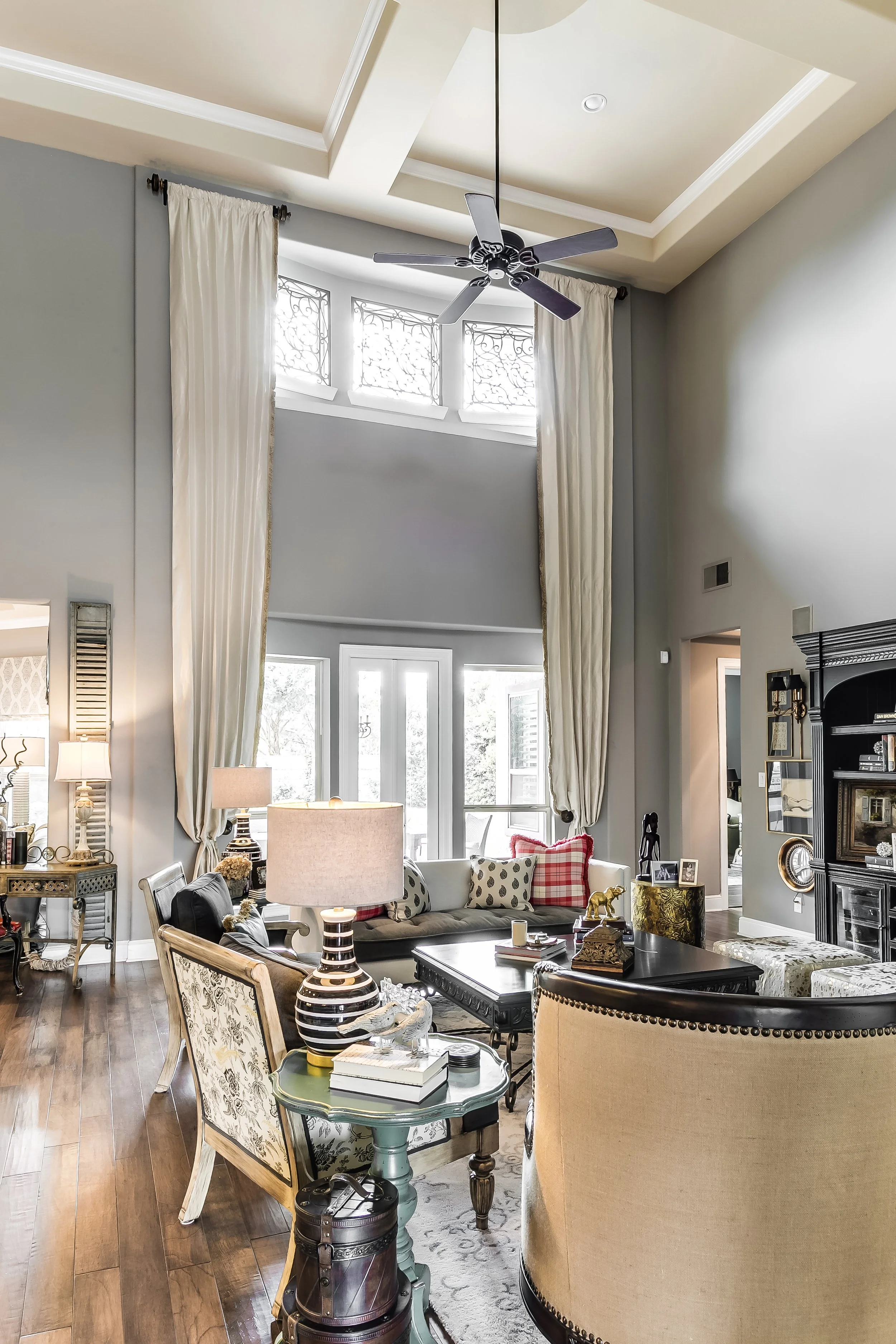
Window treatments are one of those decisions that seem straightforward until you're actually standing in the room trying to make them. Every space in your home has different light conditions, different privacy needs, and a different relationship between function and aesthetics. What does it all mean? what works beautifully in your living room can feel completely wrong in your bedroom or kitchen.
After 15 years of helping Houston homeowners get this right we've noticed the same questions come up over and over. This guide walks through each room in the house and explains exactly what to think about as well as what tends to work best so that you can make decisions with confidence rather than guesswork.
Living room window treatments
The living room is where most people want to make a design statement. It's also where the competing demands of natural light, privacy, and style are most pronounced. In Houston's open-plan homes, living rooms often connect directly to dining areas and kitchens, which means your window treatment choice affects the feeling of the entire main floor.
For most Houston living rooms, a layered treatment works best: a sheer panel that filters the intense Texas light during the day, paired with a heavier drape you can close in the evening for privacy and warmth. The sheer layer keeps the room from feeling dark while still softening the glare that's common in south- and west-facing Houston homes.
In terms of length, living room curtains should almost always floor-length. If you’re looking for a more formal look, they should ideally have a slight break at the floor or a gentle puddle. Panels that stop at the window sill visually cut the room down and make ceilings feel lower, the opposite of what most people want in their main living space.
What tends to work - Layered sheers with a linen or velvet drape panel. Floor-length. Hardware hung as close to the ceiling as possible to maximize perceived ceiling height. In Houston's climate, consider a thermal-lined back panel to reduce heat gain on west-facing walls.
Bedroom window treatments
Bedrooms are the one room where function genuinely has to come first. Houston gets enough early morning light that even east-facing bedrooms can be bright by 6 a.m., and if you work from home or have young children, blackout capability is an essential, not a luxury.
That said, blackout doesn't have to mean heavy or institutional. Modern blackout fabrics come in beautiful textures and colors, and the most elegant solution is again a layered one: a lightweight sheer or voile that you keep closed during the day for privacy and softness, with a blackout panel behind it that you only pull across when you need full darkness. This gives you full flexibility without sacrificing how the room looks during waking hours.
For primary bedrooms especially, this is an area where investing in custom fabrication pays off noticeably. Ready-made blackout panels rarely fit properly on non-standard windows, and even small gaps at the sides or top let in too much light. A custom panel fitted precisely to your window, with returns on the sides that wrap around the frame, eliminates that problem completely.
What tends to work: Blackout or thermal-blackout fabric as the primary panel, with an optional sheer for daytime use. Side returns on the blackout panel to eliminate light gaps. Floor-length. In Houston's humidity, avoid heavy velvet in bedrooms. Tightly woven polyester-linen blends give blackout performance without holding moisture.
Kitchen window treatments
Kitchens need to be approached differently than the rest of the house. Grease and steam mean you want something that's easy to clean, doesn't hang near the stove or sink, and won't accumulate cooking odors. You of course will also actively want natural light in a kitchen rather than blocking it.
Roman shades or café-style curtains (covering only the lower half of the window) are practical choices for most Houston kitchens. They give you privacy from neighbors or the street while keeping the upper portion of the window open to light. If your kitchen faces east, a simple roller shade in a solar fabric that filters UV without blocking the view can make the morning cooking hour much more comfortable without darkening the room.
In open-plan homes where the kitchen is visible from the living and dining area, it's worth thinking about how your kitchen treatments relate to what you've chosen in the adjacent spaces. They don't need to match, but they should feel intentional together. Use complementary colors or fabrics that share a similar weight or texture.
What tends to work: Roman shades in a washable fabric, café curtains, or solar roller shades. Avoid long floor-length panels near cooking areas. In open-plan layouts, coordinate color or texture with adjacent living/dining treatments rather than treating the kitchen in isolation.
Dining room window treatments
Dining rooms are often underserved in Houston homes. People put real thought into the living room and bedroom and then treat the dining area as an afterthought. But because dining rooms are typically used in the evening under artificial light, the window treatment has less to do with controlling daylight and more to do with creating atmosphere and contributing to the overall design of the space.
This is a room where you can afford to be more dramatic. Floor-length panels in a rich fabric, like a textured linen or even a velvet if the room has good air circulation, can add formality and warmth. If you entertain, the dining room is where guests sit for the longest time and where they most notice the details.
What tends to work: Statement floor-length panels in a richer fabric than the living room. Minimal layering such as a single well-chosen panel often looks better than a layered treatment in a smaller dining space. If the room is formal, consider a pinch pleat heading instead of eyelet or rod pocket for a more tailored finish.
Home office window treatments
Houston's light conditions make this more important than people realize. A home office with west-facing windows will be almost unusable in the afternoon without some form of light control. The glare on screens is severe and the heat gain from direct afternoon sun in a Houston summer can raise a room's temperature noticeably even with good air conditioning.
Solar shades are the most practical solution for offices: they cut glare and UV while preserving your view. A 5% or 3% openness factor (the lower the number, the more light they block) is appropriate for most west-facing Houston offices. If you also need privacy from neighbors, a light filtering roller shade provides that without making the room feel cave-like.
What tends to work: Solar shades for west- or south-facing windows. 3–5% openness factor for strong Texas afternoon light. Pair with a blackout blind if you also use the room for video calls where background light control matters.
Children's rooms and nurseries
This is the one room where blackout capability is non-negotiable regardless of which direction the window faces. Children sleep better and longer in genuine darkness, and in Houston where summer days are long, blackout curtains make a meaningful difference in whether your child naps or not.
Practically, children's rooms also need treatments that are durable and easy to clean. Avoid long flowing panels that can be grabbed or pulled and ensure any cords or draw strings are safely secured or eliminated entirely. ordless or motorized options are the safest choice.
What tends to work: Cordless blackout roller shades or motorized blackout panels. Easy-clean fabrics. Keep any decorative curtain panel above reaching height or fully secured. In nurseries especially, thermal blackout lining helps with both light and temperature regulation.
A note on Houston-specific considerations
A few things apply across every room in a Houston home that are worth keeping in mind.
Heat gain is a genuine issue. Houston's solar exposure means that south- and west-facing rooms without proper window treatment coverage can see significant temperature increases and higher energy bills. Thermal-lined curtains and solar shades aren't just aesthetic choices, they're practical ones that pay back their cost over time.
Humidity is harder on certain fabrics than others. Heavily textured or moisture-absorbing fabrics like untreated linen or natural cotton can sag, discolor, or develop mildew over time in Houston's climate, particularly in rooms that run humid (bathrooms, kitchens, rooms without consistent air conditioning). Tightly woven synthetic blends, performance fabrics, or treated linens hold up significantly better.
Finally, ceiling heights in Houston new builds tend to run 9 to 10 feet or higher, which is a design opportunity. Hanging curtains as high as possible, ideally at ceiling height or just below the crown molding, makes the most of those ceilings and makes every room feel more generous. This is one of the most consistent pieces of advice I give in consultations, and it costs nothing to do.
Not sure what would work best in your home?
Every room is different, and the right treatment depends on your specific windows, light conditions, and how you use the space. Schedule a free in-home consultation and Swaha will walk through every room with you.
At Curtains by Design Interiors, we help Houston-area homeowners create spaces that feel elegant, comfortable, and uniquely their own. From custom curtains and draperies to complete interior design and upholstery services, we guide you through every step — balancing high-end design with practical solutions.
Ready to transform your home? Schedule a consultation today.