
7 Interior Decorating Mistakes that Make a Houston Home Feel Unfinished
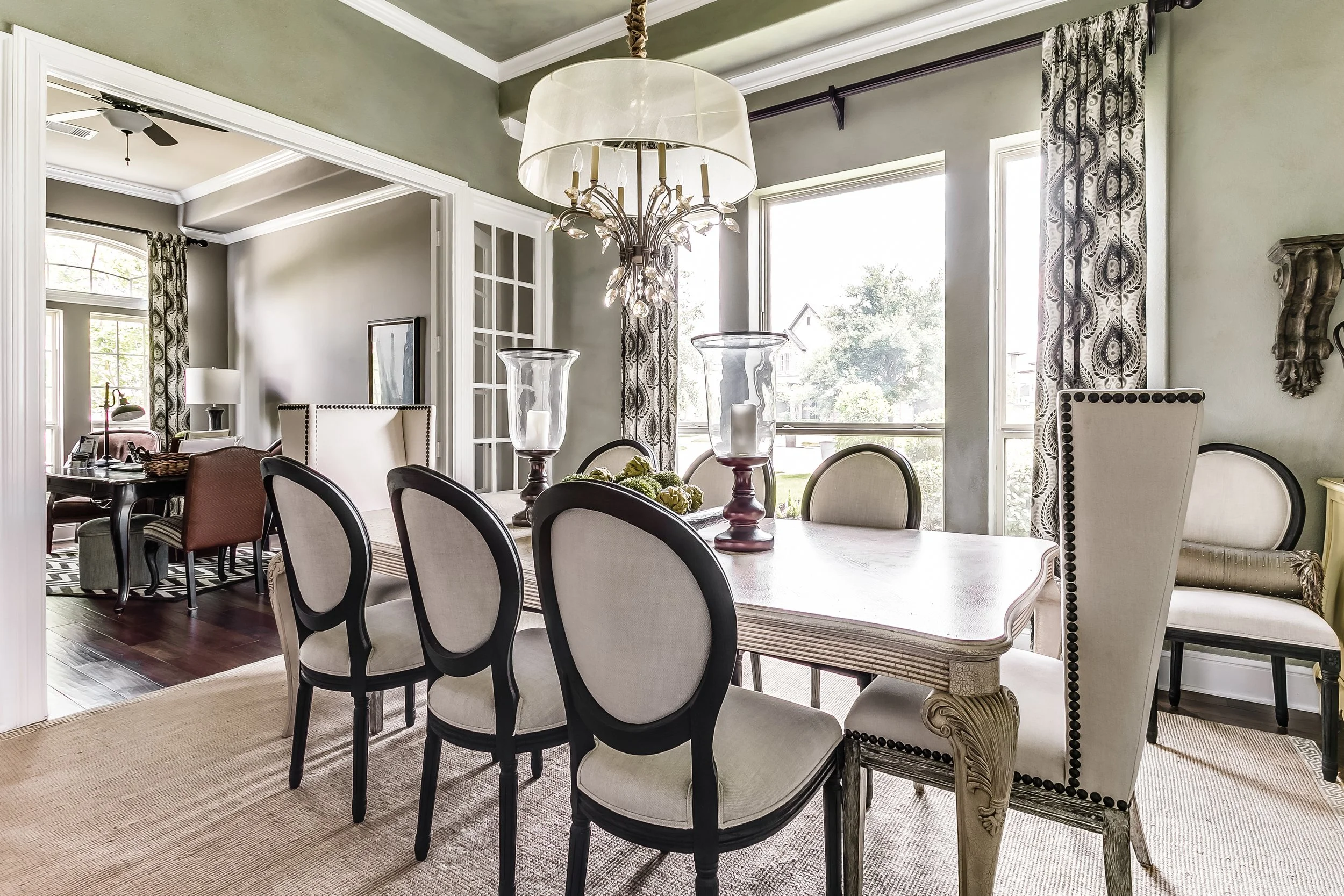
There's a particular feeling you get when a room isn't quite working. Everything is technically fine, the furniture fits, the paint color is nice… yet something is off. The space doesn't feel finished. It doesn't feel like a home.
In 15 years of working with Houston homeowners, I've walked into hundreds of rooms with that feeling. And in almost every case, the culprit isn't something expensive or hard to fix. It's one of the same seven mistakes, made in slightly different ways.
Some of these you can correct yourself this weekend. Others are worth getting help with. I'll tell you which is which.
Mistake 1: Hanging curtains at window height instead of ceiling height
This is the single most common mistake I see in Houston homes and it has an outsized effect on how finished a room looks. When curtain rods are mounted at or just above the window frame, the curtains draw the eye down to the window itself rather than up to the ceiling, causing ceilings to feel lower and rooms to feel smaller than they are.
Houston's new builds often feature 9- to 10-foot ceilings where hanging curtains at window height wastes that architectural advantage entirely. The fix is simply to mount the rod as close to the ceiling as possible (or at ceiling height if there's no crown molding) and use panels long enough to reach the floor from that height.
The Fix: Move your rod up. In most rooms, the rod should sit 4 to 6 inches below the ceiling or crown molding. You'll need longer panels than you currently have but the room will look noticeably taller and more finished immediately.
Mistake 2: Curtain panels that are too narrow for the window
Ready-made curtain panels come in standard widths and most of them are too narrow to look right when hung. A single 54-inch panel on a 60-inch window will look flat and stingy rather than full and luxurious. When you pull it open, it barely clears the glass.
The rule of thumb is that each panel should be 1.5 to 2.5 times the width of the space it needs to cover when closed. A 60-inch window with a two-panel treatment should have panels totalling 90 to 150 inches of fabric. When panels are full enough, they stack beautifully when open and look substantial when closed.
The Fix: Either add a third panel, switch to wider panels, or have panels made to the right width for your specific window. This is one of the areas where custom fabrication makes the most visible difference for the least additional cost.
Mistake 3: Ignoring how Houston's light affects your color choices
This is a Houston-specific problem that catches people who've moved from other climates. Paint colors and fabric colors that look warm and rich in a showroom or online can read very differently in Houston's intense natural light, particularly in south- or west-facing rooms. Colors that look cream-white in a Chicago apartment can look stark and almost neon-bright in a Houston living room at 2 p.m. in July.
The same applies to window treatment fabrics. A sheer that looks like a soft blush online can look almost white and washed out in direct Texas sun. Understanding how light behaves in your specific rooms is fundamental to making good color decisions. Consider which direction they face, how light moves through the day, how different the morning and afternoon quality.
The Fix: Always test paint samples and fabric swatches in the actual room at different times of day before committing. A swatch that looks right at 10 a.m. needs to also work at 4 p.m. If you're struggling to predict how something will look, this is exactly the kind of judgment call that benefits from a designer's eye. After all, we’ve seen how materials behave in Houston light across hundreds of rooms.
Mistake 4: Furniture that floats instead of anchors
In Houston's open-plan homes, one of the most common layout mistakes is pulling all the furniture away from the walls in an attempt to define a seating area but then failing to anchor it properly. Sofas floating in the middle of a large room with two feet of space between them and the wall behind them look unmoored rather than intentional.
The right answer isn't to push everything back against the walls (that reads as waiting-room furniture), but to use a rug large enough to genuinely anchor the seating group. Ensure at least one piece in the arrangement, like the sofa, is close enough to a wall, window, or architectural feature to feel grounded. Window treatments play a role here too: floor-length panels that frame the window behind a sofa connect the seating area to the wall and make the whole arrangement feel more deliberate.
The Fix: Size up your rug. It should sit under at least the front legs of all major seating pieces. Then look at what's behind and beside the furniture grouping. If there's nothing connecting the arrangement to the room's architecture, that's where a window treatment, a piece of art, or a carefully placed floor lamp does its real work.
Mistake 5: Window treatments that fight the room's light instead of working with it
This one is more nuanced than the earlier curtain mistakes and harder to self-diagnose. It's not just about having the wrong fabric or the wrong length. instead, it's about choosing treatments that are in conflict with what the room actually needs from its light.
A bedroom with heavy blackout drapes pulled all the way back during the day can look oppressive, because the panels block a significant portion of the window even when "open." A kitchen with dense roller shades that block the morning light that makes the space feel alive. A living room where sheer panels are so lightweight they do nothing to diffuse the harsh afternoon glare, leaving the room uncomfortably bright on one side and dark on the other.
Getting this right requires understanding your specific room. Take into account its orientation, its ceiling height, what happens to light throughout the day, and what you actually need the room to do. It's also the point where the choices become genuinely complex, because the right solution often involves layering two different types of treatment and understanding how they work together.
The Fix: Before choosing any window treatment, spend time in the room at different times of day and ask: what is the light actually doing in here, and what do I need it to do differently? If the answer is complex, like light control in the morning but openness in the afternoon, privacy without darkness, etc., that's a signal that a layered treatment and a professional eye will get you much further than another trip to a home goods store.
Mistake 6: Soft furnishings that were never meant to work together
This is the mistake that accumulates over time rather than happening all at once. You buy a sofa. Later you find a rug you love. Later still you choose curtains. Each decision made in isolation, each one perfectly fine on its own. However, they were never designed to work as a system, and the room never quite works together as a result.
In Houston's open-plan homes this is especially noticeable, because you're often looking at the living area, dining area, and kitchen simultaneously. When the soft furnishings across those zones were each chosen separately, the result can look like several different rooms that happen to share a floor plan.
Coordinating curtains, upholstery, cushions, and rugs doesn't mean everything has to match. In fact, matchy-matchy looks dated. It means they need to share a logic: a common palette, a relationship of textures. Creating that logic retrospectively across an existing room is genuinely difficult without a trained eye, because it requires understanding which elements can flex and which need to anchor.
The Fix: Start with the largest, most expensive pieces and work outward. Identify two or three colors from your sofa or rug that you want to pull through the room, then use those as the filter for every subsequent decision from cushions to curtain fabric to a reupholstered accent chair. If this feels overwhelming to do retroactively, a single design consultation focused on this specific problem can give you a clear, actionable plan without requiring you to start over from scratch.
Mistake 7: Underestimating the finishing details
The last mistake is really a category of small decisions that individually seem minor but collectively determine whether a room feels genuinely finished or perpetually almost-there. Curtain hardware that doesn't suit the room's style. Panels hemmed to the wrong length, like hovering above the floor instead of touching it or breaking gently on it. A rod that's slightly crooked. Rings that are the wrong size for the rod and catch instead of glide.
These details are easy to overlook when you're making them, because each one is small. But they're exactly what a visitor notices without knowing what they're noticing. They're what creates the feeling that a room was put together with care and intention — or wasn't.
Professionally installed curtains look different from DIY-installed curtains not primarily because the fabric is different, but because every detail was addressed. This includes addressing if the hem is exact, the panels hang plumb, the hardware suits the room and the stack looks right when open. That precision is harder to achieve than it looks, and it's where professional installation earns its cost.
The Fix: Step back and look at your room the way a first-time visitor would. Identify the three things that feel slightly off — not broken, just not quite right. Those three things are almost always the finishing details. Address them one by one, and you'll be surprised how much the room settles into feeling complete.
Recognize a few of these in your own home?
Most of them are easier to fix than you think and an in-home consultation is a good place to start. Swaha will walk through your space, identify what's holding it back, and give you a clear picture of what it would take to get it right.
At Curtains By Design Interiors, we help Houston-area homeowners create spaces that feel elegant, comfortable, and uniquely their own. From custom curtains and draperies to complete interior design and upholstery services, we guide you through every step — balancing high-end design with practical solutions.
Ready to transform your home? Schedule a consultation today.